

Sculpture at its best is defendably the most majestic of the arts. Its three dimensional nature advantages it immediately over every other form of human creativity. Human imagination doesn’t have to fill in the visual gaps.
But when sculpture goes wrong, as you will see in the following examples, it can descend into genre-destroying ugliness.
Our objective in this blog is to illustrate failures in choice of materials, manufacturing and installation processes, and maintenance programs. We have not set out to ridicule the artists. We have shown only those problem areas that undermine the merit of the overall work without identifying the artist.
Does this resinate with you?
1. Resin sculpture can be a durable alternative to metal, stone, wood, or concrete for an outdoor setting. If you think of a fibreglass boat as a marine sculpture, you’ll understand the stresses involved and the need for adequate reinforcement.
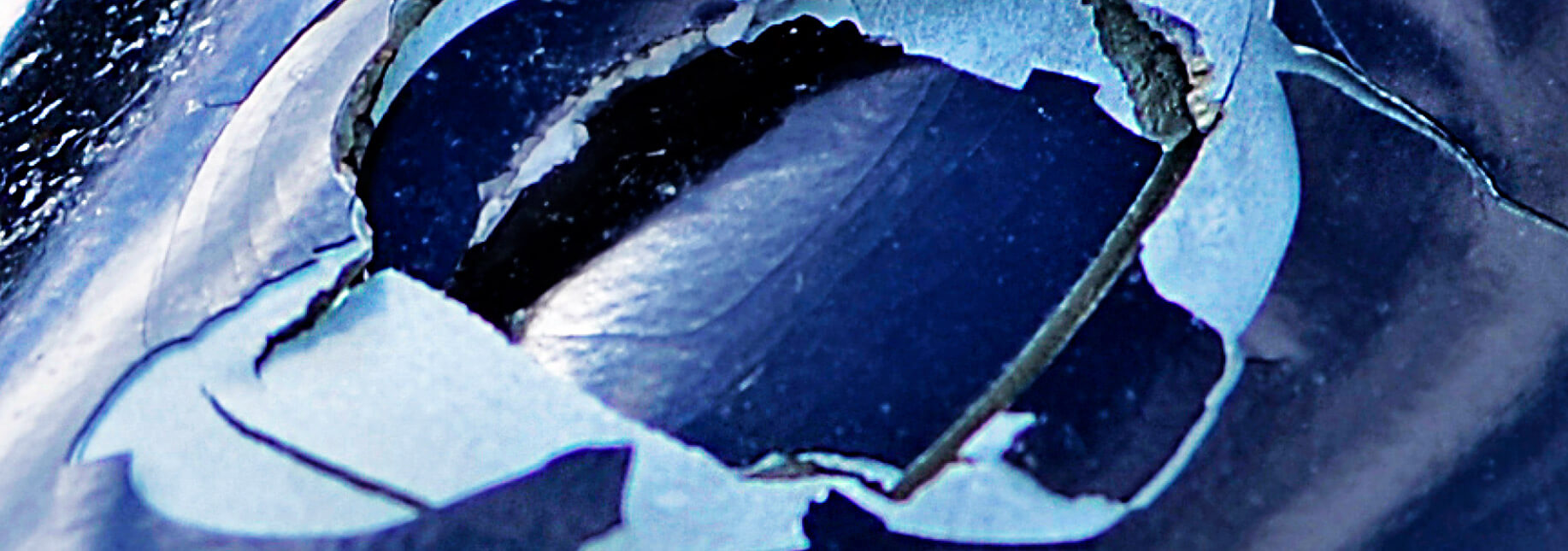
This resin sculpture has taken a knock causing an unsightly 60mm hole. There is no evidence of any chop-strand fiberglass in the substrate.
Either the artist hasn’t understood the appropriate process or hasn’t project managed the correct specifications with their production facility.
A common trick of the sculpture trade combines resin with talcum powder. It’s cheaper, provides bulk, and is easier to sand than fiberglass.
On the down side, the finished product is brittle, shatters easily in contact with harder objects, and has poor resistance to outdoor temperature differentials.
No oil painting
2. The artist’s original photo of this work shows a pristine concrete sculpture. Within months of its installation the beautifully painted concrete surface has largely peeled away.
Depending on climate conditions, concrete takes 30 days to cure, and another 30 to 60 to be ready for painting.
New concrete is very alkaline, with a pH of between 12 and 14 and a high moisture content. Both impede paint adhesion. Correct curing and drying times will give pH levels less than nine, and a moisture balance suitable for sticking power in paint.
Glass half empty
3. The artist has created a number of reflective forms in vertically hanging clustered mirror glass profiles to catch movement and reflections through the breeze. Many of the colliding forms have chipped and fractured, leaving jagged edges and glass splinters as public hazards.
The artist also used a metal rather than a rubber spigot to reduce movement in each profile, a choice of material unfit for purpose. A better option would have been highly polished #316 stainless steel — just as reflective as mirror, and much more durable.
Cor (2 out of) ten
4.) Here, the artist used faceted planes of Corten steel.
The corners of each panel are peeling up which not only looks scrappy, but presents a potential laceration and public liability hazard, particularly to children. The cladding materials were specified at about 0.8mm thickness when they should have used a gauge of between 2mm to 3mm.
At this gauge it’s much easier to achieve consistent shaping and to reduce warping caused by the heating and cooling process of welding. A skilled welder will apply heat consistently, use thinner, lower-heat welding rods, and tack or spot-weld at spaced intervals, particularly in the panel corners.
Accurately matching panel edges without gaps is another issue. The larger the gap the more heat is needed to create a puddle of molten metal between the two which increases the risk of wrap and blow through holes between the edges.
Unapeeling
5.) This is a surreal sculpture in fiberglass and resin. Given its bizarre nature, attention to detail and finish is vital to its credibility. The surface plainly lacks adequate preparation with unfilled holes, scraper marks, and uneven sanding.
It’s also evident that the surface wasn’t free of grease or primed before final painting. A tell-tale sign is the pink raw body filler (known in the trade as builder’s bog) under the peeling paint. Either the artist couldn’t manage their time properly, or lacked the technical understanding of the appropriate processes.
Someone left the cake out in the sun
6.) The artist here has come up with a creative concept of a recognisable object melting. It uses self-expanding polyurethane foam to communicate the idea. Unfortunately, it fails the test of time.
Polyurethane foam can achieve some structural strength when used to fill a closed system. But in an open application such as in this sculpture, the cell structure of the foam is larger, less dense, and therefore weaker. It is also more prone to viewers, especially children, pushing holes in it with their fingers.
The artist has painted the surface but not sufficiently to protect it from exposure to sunlight, which generally rapidly degrades these types of polymers.
A better approach would have been to use the foam to create the desired organic flow and shape in the substrate to support more durable materials forming an outer shell. I would have suggested an after-coating system that could also act as a ridged shell over the foam using a product like Plasti Dip, or resin combined with ultra-fine chopped fiberglass strand, or a commonly used fine cotton weave.
Painting over rust
7.) This outdoor sculpture was formed in mild steel coated with copper and a mirror-polished chrome finish. Within months the whole surface had corroded.
Chrome plating is not a sure way to prevent corrosion, for two reasons:
1. You can’t always trust external chrome plating factories. Many only want to make money in an industry marred by rogue operators. They are infamous for skipping the full plating process.
2. It’s difficult to electroplate irregular surfaces.
The most suitable material for this sculpture would have been #316 marine grade stainless steel for its ability to withstand corrosion in the harshest environments. While it needs specialist artisans to forge it, it is much more fit for purpose than chrome plating.
Spare the rod…
8.) This sculpture not only looks dreadful, it’s dangerous.
The construction is underestimated and under-engineered with the rods superficially welded to the inner side of a stainless steel sheet. As the welds fail, the rods become a hazard.
At a minimum the stainless steel sheet should have had holes drilled and countersunk from the outside. Each rod could then be integrated fully with the sheet, and the countersunk space between rod and sheet filled with solid weld.
An additional weld fillet could have been made on the inside of the sheet around the rod for added strength. Additionally, a slight compromise — increasing the rod size by one gauge —would have made the difference between ugly and aesthetic.
A little birdy told me
9.) Understanding purpose, design, and location should guide your decisions as both sculptor and owner.
The finish on this bronze surface has been pre-oxidised or given a metallic patina. Depending on how this sculpture is maintained, its appearance will continue to change as it oxidises further with time.
The design provides a perfect perch for birds, whose droppings will advance the chemical reaction of the patina process.
What have we learned?
The creativity of the artists in each of these examples is worthy and dynamic; the choice of materials and quality of construction less so. None will pass the test of time to transform these sculptures into legacies.
Where to now?
To understand the best approach, materials, and methods for your custom sculpture, call Todd Stuart on +61 4 5151 8865, or visit mainartery.art for a complimentary consultation. Or for further insights on commissioning sculpture, visit How to choose the right sculptor to bring your vision to life.


